MONK Blog  /  Essay

The Cup on My Table

Fragility, memory, trust, and stories: the picture of the human mind that MONK is built on, from a talk in San Francisco.

Yildirim Yazganarikan (Leo) Founder, FileMap · creator of MONK

WHERE MONK COMES FROM

This essay began as a talk I gave at Frontier Tower in San Francisco, at a symposium on AI, psychology, and consciousness. I want to lay out, as plainly as I can, the picture of the human mind that MONK is built on. It starts with an admission most software refuses to make: we are fragile.

Our thoughts and actions are guided by complex processes in the brain, the nervous system, and the body, and most of that computation is unconscious. What we can name and reason about is the tip of the iceberg. Underneath sit decades of minute feelings and gut-level processes we never see. We are suggestible. Storytelling is hypnotic. What we eat changes our chemistry. The music in the room and the story we tell ourselves in the moment steer what we do next. We never touch base reality. We only ever have our version of the story.

If that sounds abstract, try an experiment. Do not think about a flying blue whale.
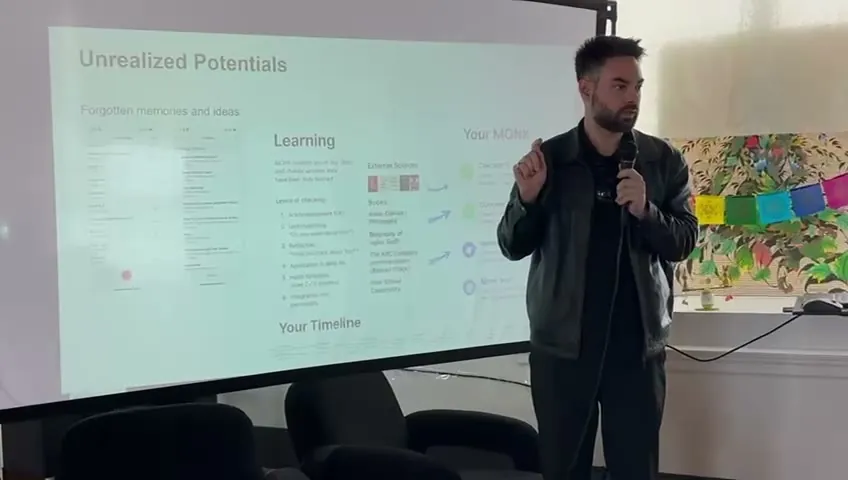
Speaking about MONK at Frontier Tower, a slide titled Unrealized Potentials on the screen
At Frontier Tower's symposium on AI, psychology, and consciousness.

FRAGILITY

A cup, a weapon, a silo

There is a large ceramic cup on my table. If someone dangerous were running at me, it would be a defense tool. On a calm morning it is a coffee cup. In a heated debate about wheat storage it becomes a silo. There is no universal tag for a cup in anyone's brain. Meaning shifts with experience, conditioning, context, and the story of the moment.

Attention is just as slippery. Even in a state of open, connected thinking, a squirrel outside the window can cost me minutes before I find my way back into flow. And memory is worse. We forget most of what we understand, no matter how vivid the insight felt. The brain was not built to hold vast amounts of information at immediate reach.


THE EXTENDED MIND

Where does the mind end?

Consider that cup again. If I list everything influencing my actions on a Monday morning, the cup is on the list. It reminds me of coffee, coffee of my habits, habits of other things, and the chain runs below words. If I meet a friend thirty times over coffee in a blue cup, and we always talk about urban planning, the cup becomes entangled with those conversations. Seeing a blue cup later nudges those neural patterns awake. The cup has become a reminder that supports and accelerates recall.

You can build with this deliberately. Point the cup handle at the houseplant when something is on the to-do list, and turn it away when it is done. After enough repetitions the eyes gravitate to the handle and the body responds before thought does. The cup is not part of the biological brain, but its influence is so entangled with thinking that calling it an extension of the mind makes practical sense. The same logic extends to rituals, spaces, and the tools we keep around us. Objects, layouts, and environments quietly participate in thought. That conviction is the ground MONK stands on.

THE CONVERSATION THE BLUE CUP THE MEMORY thirty coffees, one topic seeing the cup nudges the pattern recall arrives before words
The loop: a conversation entangles with an object, the object nudges memory, memory brings the conversation back.

AGENCY

Nothing around us is neutral

If outside stimuli influence us this strongly, how much of a decision is truly ours? Zoom out far enough and everything looks fluid, like dye swirling in water. The border between a person and their surroundings blurs. I do not have a final answer. But the practical conclusion matters more than the metaphysics: because we are this open to influence, the systems around us are never neutral. They either respect and strengthen a person's agency, or they quietly erode it.

Whoever designs the environment participates in the thinking that happens inside it.

That is not a poetic flourish. It is a responsibility.


TRUST

What trust actually needs

We open up when we trust. The thoughts under the iceberg only surface, only ripen into words, with people we feel safe with. Trust needs being listened to, being reflected back, consistency over time, and safety. Not trusting is an old survival instinct, but complete isolation starves us. What we want is simple to say and hard to find: someone with no ulterior motive, who listens, helps when needed, and gives advice with care.

Any AI that wants to sit close to a person's thinking has to earn exactly this kind of trust. And it has to deserve it structurally, in how it is built and governed, not just performatively, in how it sounds.


THE ONE QUESTION

Truth or engagement

We increasingly use AI as a thought partner, and we flatter ourselves that we control what enters our minds. In reality, once we read a sentence it diffuses into the subconscious. Even if we later learn it was false, residue remains. Falsehoods accumulate, sentence by sentence, into a quietly inaccurate model of the world.

Truth is not a feature, it is a foundation.

And transparency has to be holistic: who owns the system, how it makes decisions, how the architecture treats private data, what the agent's motives are. There is one question I would ask of any system that talks with people every day. Is it optimizing for truth and for the person's growth, or is it optimizing for engagement? Everything else follows from the answer.


STORIES

Stories that make people larger

We cannot access base reality, so we live in stories. If a class of students believes their school is where you become excellent, that belief changes how they behave, and the behavior slowly makes the belief true. Stories do not repeal physics. But shared belief shapes collective action, and collective action reshapes what exists. This is not a weakness to engineer away. It is the only interface we have to reality. The design question is whether the stories a system tells make people larger or smaller.

MONK is built from these premises. It is a voice agent with persistent memory that earns trust slowly, remembers what a person cares about, respects their fragility, and treats their attention and flow state as something to protect, not something to harvest. The measure of success is not how long someone stays in the app. It is whether the person becomes more capable and more themselves over time.

The same premises reach beyond one person. In a project with MIT City Science San Francisco, the same kind of agent translates proposed city changes into each citizen's own context, so feedback comes from understanding rather than reflex. A cup can be a weapon, a silo, or an extension of a mind. What our tools become is up to the people who design them. I want to be careful with mine.

A hand holding a phone with an incoming call from MONK; on the table nearby, a coffee cup
MONK reaching out. And yes, there is a cup on the table.

Yildirim Yazganarikan (Leo)
Founder, FileMap · creator of MONK
filemap.com · yourmonk.org
MONK Blog · ideas and experiments on education, collaboration, and AI